North Alabama has been essential to every major American victory in the 20th Century, and we are once again poised to deliver for the 21st.
There would not have been enough munitions for the Great War without the nitrate plants in Muscle Shoals.
There would not have been sufficient electricity for Oak Ridge to make the nuclear bomb that ended World War 2 without the electricity generated by TVA in Alabama. And, famously, there is no winning the Space Race without the Rocket City.
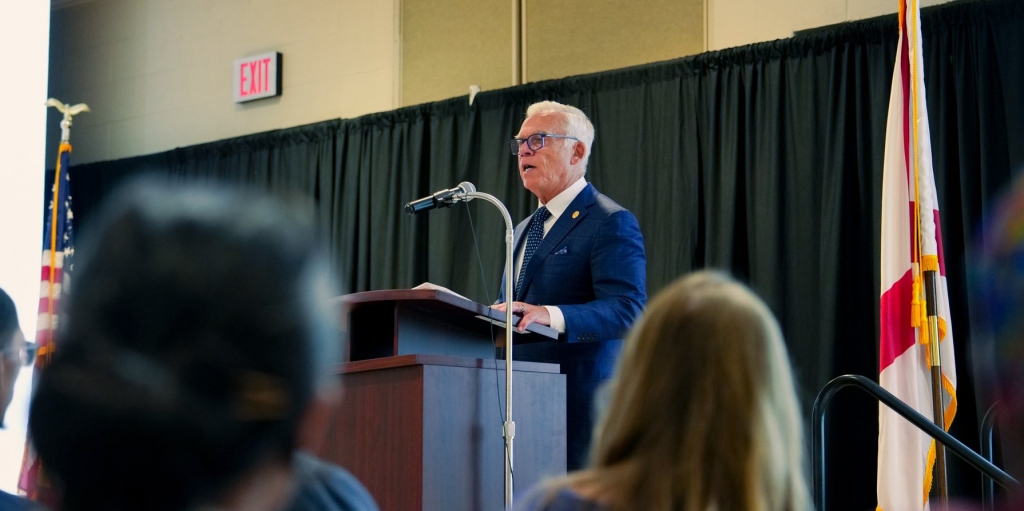
In fact, for every American conflict, popular or unpopular, our children have bled for the Stars and Stripes. It made me particularly proud to be an Alabamian when I hosted two 50th Anniversary Vietnam Veterans Pinning Ceremonies earlier this year.
Not only was I humbled to meet so many local heroes, but I was also overwhelmed by the community turnout showing just how much we celebrate our servicemembers.
Today, one of my major priorities representing North Alabama in Congress is to make sure we make the necessary preparations for this new era of strategic competition against the Chinese Communist Party and its enablers.
To borrow from the Chinese philosopher Sun Tzu: ‘In times of peace prepare for war, in times of war prepare for peace.’ For years, I have been warning that we are not prepared.
In my 2022 address to the Huntsville/Madison County Chamber of Commerce, I warned that America was developing what I called a “Security Gap” — the growing difference between what we invest in our national defense and what it truly takes to keep pace with our adversaries. The very weapons of war we rely on to fight our adversaries cannot be built without them.
We have never won a major war by relying on the charity of our enemies. In truth, both World Wars were fought and won both on the battlefield and on the factory floor.
Famously, Joseph Stalin, hardly a fan of United States capitalism, cheered ‘to American production, without which this war would have been lost.’
The ‘Arsenal of Democracy,’ as President Franklin Roosevelt coined it, was powered by an immense civilian contribution from men and, for the first time, women who heeded the call from our nation’s factories.
But while the heroism of our soldiers, sailors, and airmen is well-known, the sacrifice of the American laborer is relatively unsung. Make no mistake, war production was not for the faint of heart. U.S. historian Arthur Herman estimates that in 1942, the number of workers who were killed or injured in the U.S. industries outweigh the number of Americans killed or wounded in uniform by a factor of twenty to one.
While production in the 21st century is thankfully safer, our capacity to create has shrunk dramatically from the heights of the 20th century. This is especially glaring when compared to the resources of the Chinese Communist Party.
While our shipbuilding is more than 11 years behind schedule, China’s shipbuilding industry has over 230 times the capacity of the U.S.!
While our major acquisition programs average 11 years to deliver their first capabilities, China’s procurement programs move 5-6 times faster.
If we are to win the next world war, we must reverse this trend. As a senior member of the House Appropriations Committee, I have the privilege and responsibility to ensure that our federal budget addresses our capacity crisis.
From my position on the Defense Appropriations Committee, I see the three most urgent vulnerabilities in our defense industrial base as resources, energy, and production. You’ll note these are issues that affect both our military and every single citizen.
Thankfully, Republicans in Congress are working with the Trump Administration to address these at breakneck speed. For resources, the Administration is making strategic agreements on trade, and investments both across the globe and here locally to enhance our workforce.
For energy, the mantra of ‘drill baby drill’ is resonating and we are once again on a path towards energy independence, all while chasing a new paradigm of cheap, safe, and reliable nuclear energy – led in Congress by our neighbor Congressman Chuck Fleischmann of Tennessee who Chairs the Appropriations Subcommittee for Energy & Water.
Lastly, most importantly, American manufacturing is positioned to make a comeback thanks to the low taxes on families and companies made permanent in the One Big Beautiful Bill (OBBB).
Perhaps less well-known, is that the OBBB also contained significant investments in the U.S. defense industrial base.
Whether for the Golden Dome that will keep us safe or the shipbuilding that will safeguard our global reach, the Alabama Congressional delegation has worked tirelessly to highlight the opportunities here at home.
I opened this piece by demonstrating how Alabama’s success is America’s success. Nowhere is there a more powerful symbol of the need for a comeback than in Muscle Shoals.
What was once a flourishing production plant for American-made rail cars shuttered as the company chased marginal cost-savings by moving the jobs overseas to Mexico.
But change is coming. Through President Donald J. Trump’s executive actions on ‘Restoring America’s Maritime Dominance’ and ‘Modernizing Defense Acquisitions and Spurring Innovation in the Defense Industrial Base,’ our country is turning a new page.
Through my own work on the appropriations Committee and the reconciliation bill known as the One Big Beautiful Bill, Congress is also dedicating specific resources to reinvigorate this immense facility as a collaborative campus for our Maritime Industrial Base.
There is a long road ahead until the old railcar facility is back on track, but I am grateful to serve this area and to partner with those who believe in our State.
I will end with the caution, that there is no returning to the factories of yore. We have to move forward and we should. While it is imperative that we restore our industrial capacity, we should look to benefit from the technological advancements that separate us from the 20th century.
Factory workers of the future will be empowered by the tools of automation, AI, and digital engineering to work in a safer and more prosperous environment than our ancestors.
We should be thankful for this technological revolution and embrace innovation the way Alabama always has.
Robert Aderholt (R-Haleyville) represents Alabama’s 4th Congressional District. He is a senior member of the House Appropriations Committee.