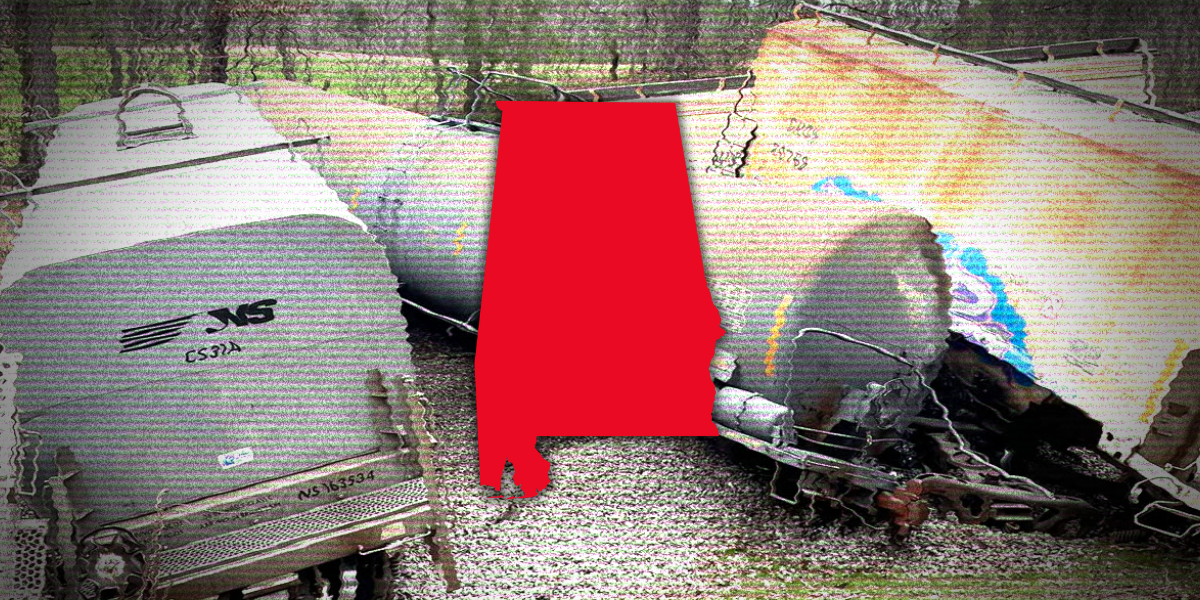
The South’s railways keep America’s economy in motion, transporting a significant share of our nation’s energy exports, agricultural goods, and automotive freight across the nation and to the Gulf ports.
They are the backbone of our region’s industrial success and the critical link between America’s producers and the fast-growing Gulf Coast ports that anchor U.S. trade, and the economic benefits that come from a strong, resilient supply chain.
But even the most effective systems can falter under massive mergers.
In November, two of the nation’s largest freight railroads, Union Pacific and Norfolk Southern, announced their intent to merge, creating a singular rail network that would control roughly 40 percent of all U.S. freight rail.
As a partner of Sweet Brew Tea, one of the fastest-growing beverage manufacturers in the country, based right here in Alabama, we have deep roots in the state’s economy.
Consequently, I understand the challenges Southern businesses face in keeping products moving. While not all mergers are bad, one of this scale calls into question a monopoly and risks rerouting freight patterns that directly affect the Gulf ports’ competitiveness and capacity to handle global trade efficiently.
A properly executed merger can drive innovation and fortify operations, but Union Pacific and Norfolk Southern have yet to describe how their partnership would meet the Surface Transportation Board’s (STB) requirement to “enhance competition” or benefit shippers and customers across the South. And policymakers and industry leaders are rightfully taking notice.
On November 14, nine attorneys general, including Tennessee Attorney General Jonathan Skrmetti and Mississippi Attorney General Lynn Fitch, sent a letter to the STB urging them to protect industries from the negative ripple effects of consolidation.
The attorneys general requested the potential merger be held to the highest standards of competition and warned the deal could result in congestion that “creates higher prices, lower reliability, and less innovation at the expense of America’s manufacturers and, ultimately, America’s consumers.”
I applaud their effort to safeguard the industries that fuel our country’s economy. Nowhere is that more important than in the South, where rail is the lifeline of the region’s energy and port economies.
From traditional oil and gas to petrochemicals and containerized goods, Gulf Coast ports move a massive share of the nation’s exports, and every shipment depends on reliable, competitive rail access.
But a mega merger would give one company outsized control over the routes feeding our ports, letting a single operator set shipping terms and prioritize its own traffic at the expense of others.
These effects will trickle down to farmers who already operate under slim margins and rely on freight rail to bring crops to market. And local shippers who move grain, soy, fertilizer, and other commodities through the region face the same uphill battle.
The results? Congestion, higher costs, and slower service that ripple outward from port terminals to energy producers, farmers, and shippers alike.
Under a near monopoly, these small and mid-sized players that play a crucial role in our economy would have no leverage to push back against rising rates or delays.
Put simply, reduced rail competition would strain these businesses, even putting some at risk of closure, causing irreparable harm to local economies.
The impact runs even deeper.
Gulf Coast ports are America’s fastest-growing trade gateways, driving billions in export growth and job creation. Today’s competitive rail system allows goods to flow seamlessly from inland producers to coastal markets. But if consolidation creates chokepoints or limits capacity, the economic ripple will be felt far beyond the port and the rail corridors that lead to the Gulf.
I urge the STB to heed the attorney’s general warning: if the southern rail competition falters, so will the ports, industries and communities that rely on its services.
It is fundamentally unfair to expect the very producers, farmers, shippers, and manufacturers driving our growth to compete in a system where they have no leverage, no alternatives, and no guarantee of reliable service.
Our systems are only as strong as their smallest players. When considering a merger of this size, every stakeholder must be accounted for.
Protecting fair rail access isn’t just good for the South, it’s vital for our entire country’s economy and those who keep America moving.
Adam Stewart is a Partner at Sweet Brew, based in Loxley, Alabama