161 years ago yesterday, Robert E. Lee surrendered his Army of Northern Virginia to Ulysses S. Grant and the Union. Although the war technically lasted for months longer, this occasion effectively brought the Civil War to a close. The face of the South humbly accepting defeat that day in 1865 was more resounding than any official end of hostilities altogether.
I’m a proud descendant of both sides of the war. I have ancestors who died fighting against each other. Both were gallant in their efforts to preserve their way of life and fought for a cause they deemed worth dying for.
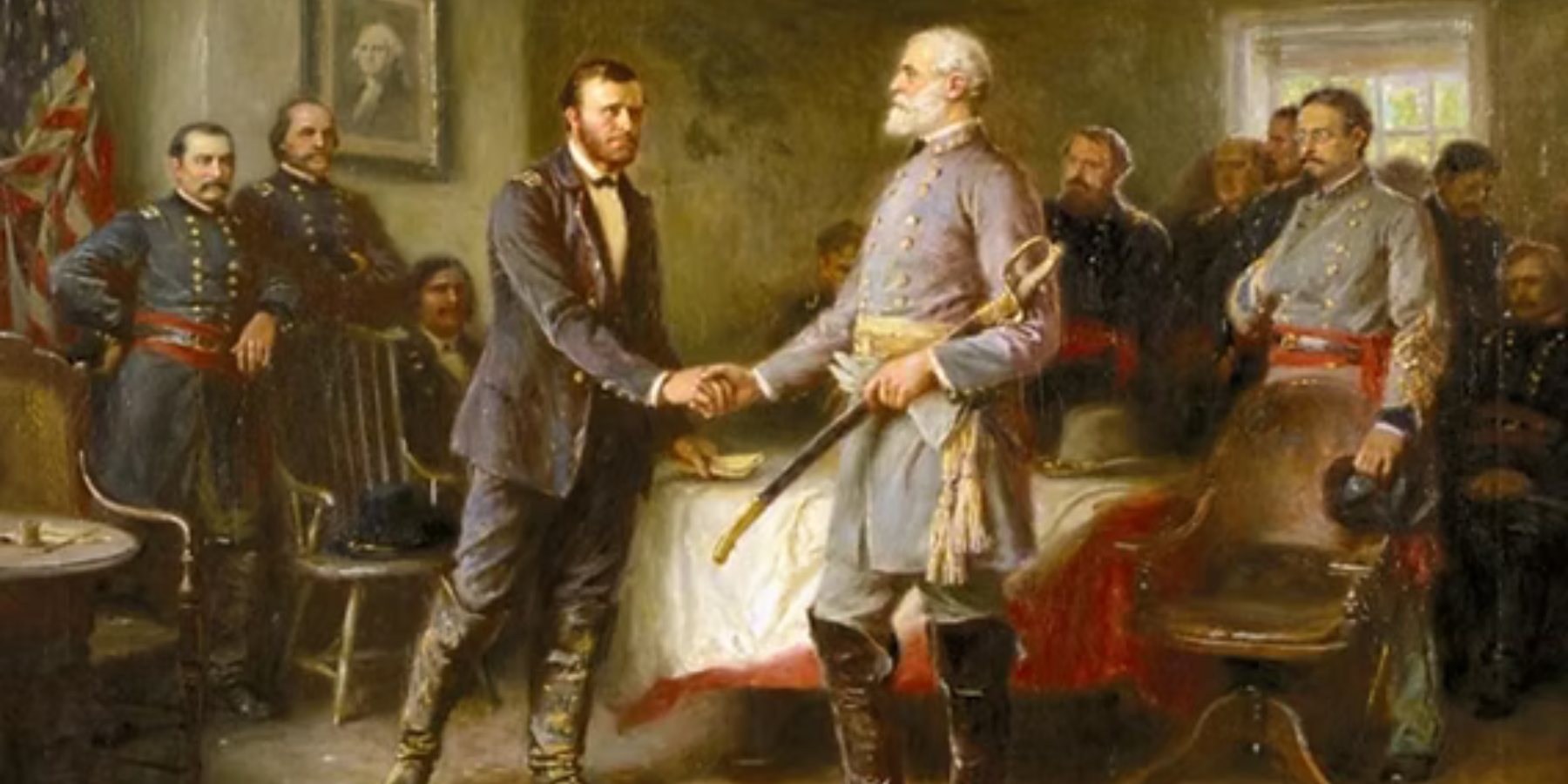
I’m one who loves portraits. I believe they tell a story better than any words written on paper could ever express. It’s hard to encapsulate the entire war, not just the surrender, any better than the portrait of Grant shaking the hand of Lee that day.
Grant, with his boots covered in mud and his uniform overwhelmingly casual for an occasion such as this, was the perfect example of pulling yourself up by your bootstraps. A notorious drunk and an all-around failure in life, he eventually found himself General of the Union Army and was tasked with cracking the code that was Robert E. Lee. Lincoln desired a general who “understood the arithmetic” to defeat the Confederacy, and Grant was exactly that. His humble appearance on that day, while standing victorious, told his story impeccably.
Standing across from him was the great Robert E. Lee. With his spotless military uniform and sword in hand, he was the textbook example of chivalry. The fox that haunted the Union for the entire war was finally cornered, and yet even in defeat, his presence commanded attention. A military genius with a remarkable resume, his appearance on that day was fitting. His brilliance and military record were not enough, however. He was a defeated man, but even in defeat, he accepted it honorably.
You’d be hard-pressed to fill a room with two more honorable men than Generals Grant and Lee on that day. As I reflect on this moment and try my best to picture myself in that room, I’m filled with despair. Even after being at war, the leaders of both sides held each other in such high regard. As Lee was leaving that day, conquered and humbled, the soldiers of the Union started to cheer in his presence. Grant demanded they stop, and later reflected on why: “They were now our countrymen. We did not want to exult over their downfall.”
As an American in 2026, this quote hits you at your core. It represents the fact that in 1865, after the nation was divided by a war over secession, they felt they had more in common than we do today. Americans today are more divided and distant from one another than ever before. Yes, even more than in 1861. Our civil war is cold, but undoubtedly more intense.
The men who fought on both sides of that civil war all shared the same traditional values. They agreed on what a woman was. They valued their families and cherished the tradition of carrying on their heritage. They were passionately patriotic for their cause and noble in both victory and defeat. Their war was one over an issue that was kicked down the road by every founding father who came before them. Slavery was a moral evil that had to be eradicated, not just for America, but for every slave who had their God-given freedoms stripped from them. Despite this disagreement, the men who fought each other had infinitely more in common than we do today.
If you made a road trip around the nation and drove through the Bible Belt, then to Los Angeles, north through Seattle, all the way back east through Chicago and New York, before finally circling back to Dixie, you’d think you visited five different countries. Some may say this is a good thing. But if your nation is that diverse, not just in lifestyle but in worldview, what exactly is the thread that connects us all? What is the uniting belief among us Americans? When certain parts of the nation believe in Christian values and hold pro-American beliefs, while the other half believes in pure degeneracy and wishes for America’s downfall, how do we proceed?
I would argue the answer is not to conform to the beliefs that are antithetical to those that made this nation. America became one of the best countries in existence due to the influence of Christianity, individualism, capitalism, and the pursuit of happiness. Those who actively fight against these beliefs are inherently working against everything this country is about.
As Americans, we must fall back on what we have in common. To accomplish this, we must once again agree upon what it means to be an American. We solve this through open dialogue, but most importantly by getting involved and engaged in the political system around you. The same way that Portland became a new version of Sodom and Gomorrah with rampant drug abuse and debauchery, you can fight to keep your own community from falling to this by speaking up and taking action.
Perhaps the best quote from that day in Appomattox on April 9, 1865, came from Ely S. Parker, a Native American and an officer in the Union Army. When Lee noticed Parker, he extended his hand and said, “I am glad to see one real American here.” Parker replied, “We are all Americans.”
For us to once again feel connected as a nation, and to finally end this cold civil war we find ourselves in, we must redefine what it means to be an American. Only then can we move forward and preserve our great nation.