One Hundred Fifty years ago, a small business in Pittsburgh filed for bankruptcy protection.
The H.J. Heinz Company was forced to take this action when the national economy soured, its contractual obligations were over extended, and the company could not pay its debts.
This public humiliation could have marked the end of the company and curtailed the entrepreneurial spirit of Mr. Heinz, but in many ways, the bankruptcy became a catalyst to work even harder to re-build and prove a point by achieving commercial success.
The Heinz Brand is known around the world today, but in 1875, it was much more localized. Henry Heinz was the son of German immigrant parents who settled in Pennsylvania, and as most people did in those days, the family had a small garden to supply fresh vegetables for their dinner table. Young Henry sold excess produce and enjoyed the extra jingle from the money he made.
Catching the entrepreneurial spirit, Heinz began growing more vegetables exclusively for sale, and because he did so well, his parents purchased a small plot of less than an acre so he could expand his efforts.
Horseradish was particularly popular in his community, but it was time consuming, difficult to make and the odor of the process could be very powerful. Heinz realized he could use horseradish roots from his garden, make the sauce using his family recipe and then sell the finished product around town.
Others sold homemade sauces too, but distribution was limited to a small area as refrigeration and preservatives had not been discovered to prolong the shelf life of these condiments. Since spoilage was a problem, to prevent this, opaque bottles were used to limit exposure, but also to mask the quality of the product. Brown bottles simply made it hard to gauge the freshness of the sauce.
Heinz decided to use clear glass bottles so people could see how fresh his ingredients were; thus, distinguishing his product from any competitors. The consuming public welcomed and appreciated this innovation and as Heinz predicted, sales increased.
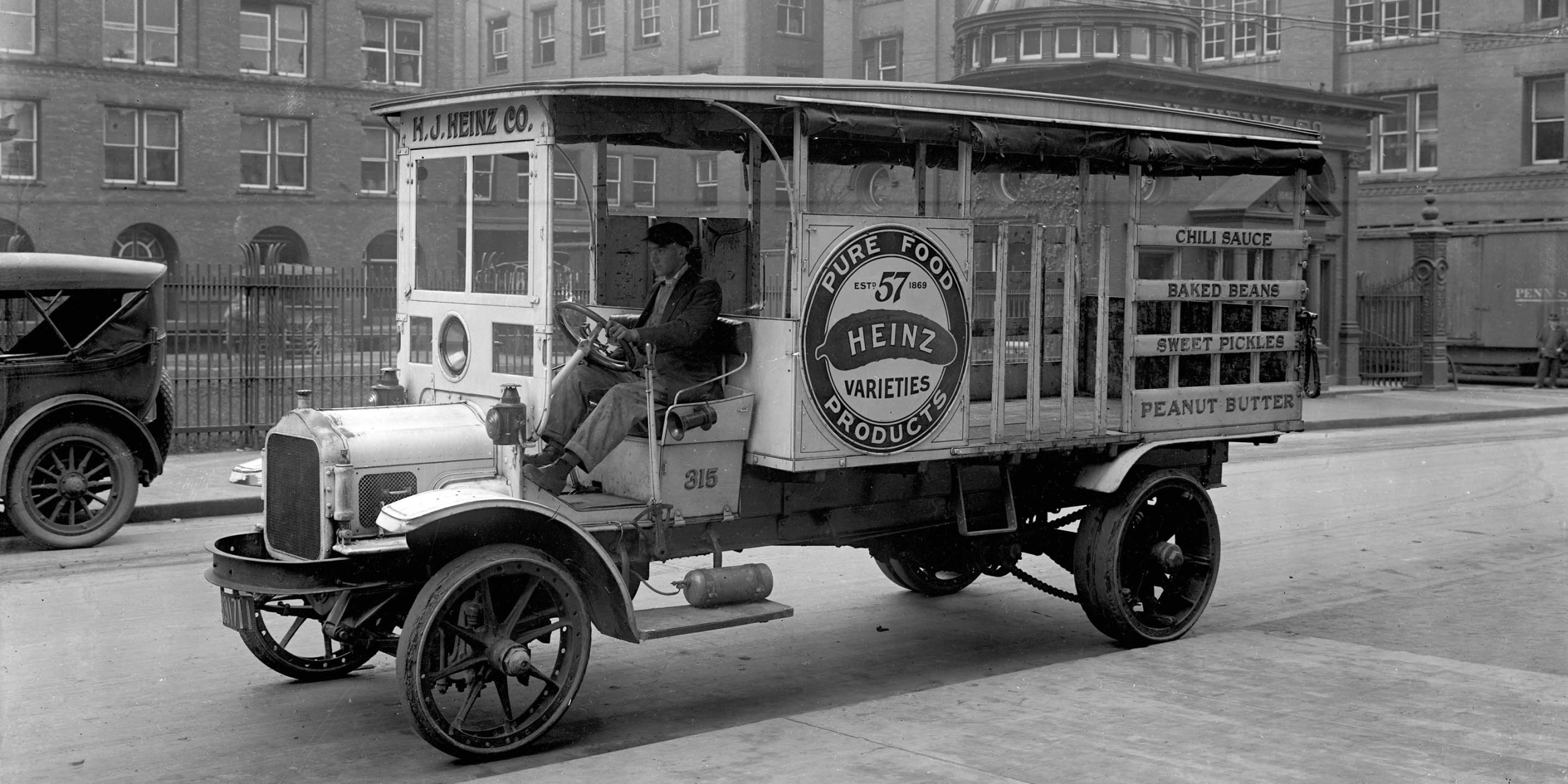
On a small scale, Heinz had an integrated company. He grew the vegetables, built a manufacturing facility to produce his sauces, and had transportation to deliver his products to consumers.
From horseradish, he expanded into other sauces and condiments. Since vinegar was a key ingredient of horseradish, he developed a process to make vinegar, which could also be sold as a standalone product. And, because vinegar was also used to make pickles, any excess could be used to further expand his products to include canning pickles.
Basic ingredients like vinegar and salt were part of making other products, so as one thing led to another, his business expanded to include other sauces, including mustard and something that became closely associated with the company, ketchup, or as they referred to it at the time, catsup.
At age 25, Heinz needed more capital to further expand his company, so he borrowed to finance and admitted new partners to help manage the growing company. In the atmosphere of the post-Civil War period, the American economy expanded as the nation reunited and rebuilt. Railroad expansion created jobs, promoted investment, and opened areas of the country to greater trade.
Heinz grew its markets, too, but when a global depression created the panic of 1873, demand for consumer goods and the convenience of sauces and condiments diminished rapidly.
Despite taking steps to ward off and limit the impact of this panic, Heinz was faced with hard choices. He was further squeezed by a contract obligating him to purchase all the cucumbers produced by a vendor, but as prices fell and cucumbers were in abundance, he was unable to process, much less sell, pickles.
The situation proved untenable, and he was forced to file for bankruptcy; it was not a pleasant Christmas for his family and Heinz developed a deep depression.
Heinz’s partners blamed his ideas for expanding the company’s market as a reason for the bankruptcy. Even in his depression, his religious faith compelled him to persevere, learn from his mistakes, and start all over again. Encouraged by his mother and pooling money from his immediate family, Heinz was soon back in business.
Using his tried-and-true methods of growing his own produce for manufacture, he moved back to his clear glass bottles with his staples of horseradish, mustard, ketchup, and vinegar. Heinz realized that before the panic, he had created a demand for his products, and while the collapse of the business removed them from the market, once he was back up and running, albeit on a much smaller scale, the demand remained.
With his commitment to integrity and as a man of his word, even though not obligated to do so, Heinz paid back all the debts that had been discharged in bankruptcy. He learned not to rely on debt financing, but to grow the company by plowing its profits back into the business. This created slower, but steadier growth; before long, the company was earning substantial profits, building new factories, and expanding its markets.
Heinz was one of the first American companies to export his products overseas, and here, too, he created a market to meet the need of providing ready-made food condiments. Over time, Heinz would use global trade to further develop and diversify his company.
From his use of clear bottles to show consumers how fresh and appealing his sauces were, he assisted the federal government in developing the Pure Food and Drug Act. Heinz would not be the last entrepreneur to use government regulations to eliminate competitors. He promoted pure, high-quality goods for consumers while advocating that his self-imposed high standards should serve as the base line for federal regulations of other companies.
Thus, from the depressing failure of bankruptcy rose an international company that identified a niche market, created a demand, and met a need that continues to this day.
Truly, from the ashes of disaster grow the roses of success.
Will Sellers is a graduate of Hillsdale College and is an Associate Justice on the Supreme Court of Alabama. He is best reached at [email protected].