Two very different visions of how the American Revolution might end were converging on New York Harbor 250 years ago.
One was diplomatic, cautiously optimistic, and carried across the Atlantic in the person of Admiral Richard Howe. The other was ideological, uncompromising, and had just been signed in Philadelphia.
Within weeks, the brutal arithmetic of the battlefield would determine which vision mattered.
The Battle of Long Island, fought August 27, 1776, was where the soaring language of the Declaration of Independence faced the existential question of whether it could be defended by force of arms.
When Parliament authorized the brothers, General William Howe and Admiral Richard Howe, to lead the largest expeditionary force Britain had ever assembled, it did not send them purely as conquerors. The Howe brothers held a dual commission; military commanders empowered to crush armed rebellion and official peace commissioners, authorized to negotiate an end to the conflict. This apparent contradiction reflected a British uncertainty about the nature of the Revolution.
Richard Howe was sympathetic to American grievances and had cultivated friendships with colonial leaders, including Benjamin Franklin. He accepted his command partly in hopes of brokering peace rather than winning a war. Parliament’s authorization allowed the Howes to grant pardons to colonies and individuals who renounced rebellion and submitted to royal authority.
The underlying assumption was that the rebellion was the work of a radical minority, that most colonists remained fundamentally loyal or at least persuadable, and that a combination of overwhelming military might and generous terms would bring the colonies back into the empire without a prolonged war and occupation.
From London’s perspective, a negotiated settlement seemed like a real possibility, right up until the moment the Howes’ ships appeared off Staten Island.
The timing could not have been worse for their mission. Congress adopted the Declaration on July 4, and it had been read aloud to Washington’s assembled troops in the same city where the Howe brothers hoped to open peace talks.
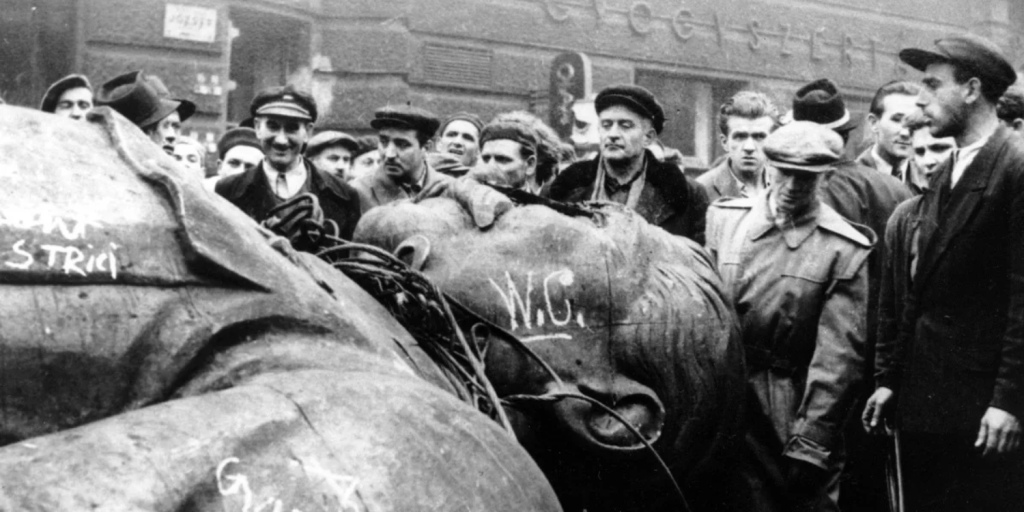
The reaction of New Yorkers to hearing the Declaration was unambiguous as soldiers and civilians pulled down the gilded equestrian statue of King George III on Bowling Green, later melting much of it into musket balls.
The Declaration asserted that the colonies were now “Free and Independent States,” absolved of allegiance to the British Crown, which was a de facto rejection of the entire premise underlying the Howes’ commission.
Pardons are meaningless to a government that no longer recognizes the authority offering them, so when Richard Howe attempted to open communication with American leaders, the talks collapsed almost immediately.
Howe offered amnesty and reforms within the empire, but the American delegation desired nothing less than recognition of an independent country, and this desperate gulf provided no common ground for negotiations.
In effect, the Declaration converted an internal colonial dispute into a claim of full sovereignty, and it did so at the exact moment Britain’s peace apparatus was arriving to resolve what it still understood as a small rebellion.
Parliament’s optimism for compromise was not defeated by a battle. It was defeated by a Declaration that changed the nature of the war legally and politically.
But declaring independence and possessing the military power to secure it were entirely different matters. Long Island exposed that gap with brutal clarity just seven weeks after the Declaration’s signing.
Washington’s army was organized and equipped as a colonial militia not a professional fighting force. It was unprepared for conventional warfare and holding fortified positions against a British army of over 20,000 regulars and Hessian mercenaries, backed by the world’s most powerful navy.
The result was close to catastrophic. General William Howe exploited a poorly guarded route to outflank the American position, collapsing Washington’s defensive line and inflicting heavy casualties and mass captures. Only Washington’s skillfully executed nighttime retreat across the East River saved the Continental Army. It was, in the starkest possible terms, a demonstration that sovereignty declared in Philadelphia meant nothing if it could not be defended in battle.
This was the essential tension of August 1776: independence was a legal and political fact the moment Congress declared it, but it remained a fiction until proven otherwise on the battlefield. Long Island exaggerated this competition between fact and fiction.
The gap between the confident universal language of the Declaration and the desperate reality of an outmatched, retreating army was, for a few days at the end of August, dangerously wide.
Long Island taught Washington that his forces could not fight the British as European armies fought, and that lesson reshaped his entire approach to the war. Attempting to match British discipline, training, or firepower in a symmetrical, fixed-position battle risked losing the only asset that mattered: the Continental Army itself.
Out of that recognition came the strategic philosophy that ultimately won American independence. Washington shifted from defending territory and prestige positions to preserving his forces above all else, treating retreat as a legitimate tool rather than a disgrace.
Rather than committing to decisive, all-or-nothing confrontations, Washington moved toward a war of attrition and selective, high value strikes as evidenced in the calculated risk-taking at Trenton and Princeton later in December.
He learned to trade space and time for the survival of his army, betting that a protracted conflict would erode British political will and resources faster than it would exhaust an underfunded, poorly supplied Continental force that knew both the territory and the severe consequences of defeat.
This was, in essence, an early American education in asymmetrical warfare in which the weaker conventional force secures victory not by matching the stronger one’s strengths, but by refusing to fight on the terms and territory dictated by the superior force.
The Declaration wrote the nation into existence through words and colonial consensus. Long Island forced Washington to understand that securing it would require an entirely different kind of war than Parliament, the Howes, or even Washington himself initially imagined.
250 years ago, securing independence by the pen required validation by the sword.
Will Sellers is an Associate Justice on the Supreme Court of Alabama. He is best reached at [email protected].