This past summer, I experienced a treat I didn’t expect would happen again in my lifetime. A covey of bobwhite quail made their summer home in the acreage around our home in Baldwin County. I cherished each “Bob-White” mating call I heard and caught glimpses of them entering several areas with thick vegetation.
That thick vegetation that provides protection for brood-rearing is one of the key ingredients for quail to survive and thrive, according to Caleb Blake, the Upland Game Bird Coordinator with the Alabama Department of Conservation and Natural Resources’ Wildlife and Freshwater Fisheries (WFF) Division.
“While we are not at the population we once had, where there is adequate habitat, I would say there can be or are stable populations if you know where to look,” Blake said. “Quail populations, in general, are stable. We’ve had about 80% decline in the past few decades. People look at the 1960s as the beginning of the decline, but that was just when we first started looking and doing the breeding-bird survey. It has probably been declining since post-World War II.
“Historically, in the 19th and 20th centuries, farm practices were able to boost quail populations. They were a byproduct of what we call ‘messy’ farming with more fallow areas, more hedgerows and smaller fields.”
Then came modern farming techniques that allowed soil disruption from fencerow to fencerow on higher acreage.
“That diminished the beneficial habitat,” Blake said. “The areas that once boosted populations were gone, and we saw a drastic decline. Higher efficiency farming and urban development contributed to the decline.”
Another area with habitat decline is the Alabama Black Belt, where quail once flourished.
“Historically, the Black Belt was a prairie,” Blake said. “It still is wide open, but the majority of it is cow pasture. The grass planted for cattle is poor quail habitat. Even though it is wide open, it’s still inadequate habitat for bobwhites.”
Alabama’s booming timber industry also played a role in the reduction of quail habitat.
“Alabama once had abundant prairie ecosystems with longleaf pine and oak savannas,” Blake said. “What we see in Alabama today is not what it looked like 200 years ago because of the increase in the timber industry. You can have a happy medium with the timber industry and bobwhite quail management. The problem is the density in which we plant trees and a lack of thinning, which makes the property unsuitable for managing quail habitat. We try to find a happy medium, but, in many areas, there are too many trees for suitable quail habitat.”
Blake is a diehard proponent of making prescribed burns an integral part of timber management.
“For some of the timber, a lack of an active burn rotation is a problem,” he said. “From an economic standpoint, fire is the cheapest and most beneficial practice that we can encourage landowners to use on their properties. Historically, the ecosystems in Alabama have evolved with frequent fire running through the landscape, helping to keep woody encroachment under control and promoting early successional habitat. The disappearance of frequent fire on the landscape has coincided with the start of the decline of bobwhites.”
Blake said another timber management practice that is beneficial to quail and other small game is thinning to keep the forest below a certain density.
“By opening up the canopy, it allows more sunlight to hit the ground,” he said. “That promotes the growth of native grasses, forbs and shrubs that increase quail habitat on the forest floor.”
Blake also said that the proper distribution of herbicides can also be important for improving quail habitat.
“There are so many invasive species out there, it has diminished the quality of the landscape,” he said. “Herbicide, fire and thinning are in the magic toolbox for creating quality quail habitat.”
Despite the decline in quail numbers, Alabama is still home to a dedicated group of quail hunters
“Alabama has such a rich tradition of quail hunting,” Blake said. “We’ve seen a dedication from landowners and the public to stabilizing the decline or reversing the decline. Several large private properties across the state have been actively managing and have healthy wild populations.”
Blake said those who don’t have access to those large acreage areas can still work with neighbors to improve quail habitat. Some upland biologists say most landowners will need about 1,500 acres to successfully create enough quail habitat for a sustainable population.
“Obviously, most people don’t have that much land,” he said. “The key is to build relationships with neighbors. If you have 200 acres, and you have 10 neighbors with similar acreages who are willing to work with you, you will have 2,000 acres. Small acreage doesn’t mean it can’t have an impact. What it means is landowners working together to improve the quail habitat.”
Quail hunting still has a big economic impact in the state with numerous plantations across the state that attract hunters from across the nation.
“Alabama is a quail hunting destination,” Blake said. “Even with the decline, there is still a high value for quail hunting in the state, even if it is liberated quail. When I talk to people about quail, there is always that nostalgia and fond memories of hearing their whistles. You hear people talk about growing up and hunting with their grandpa or their dad, and there is still that rich tradition and desire for quail hunting.
Visit https://
Blake said there is also a group of dedicated hunters who pursue quail on public land, including him.
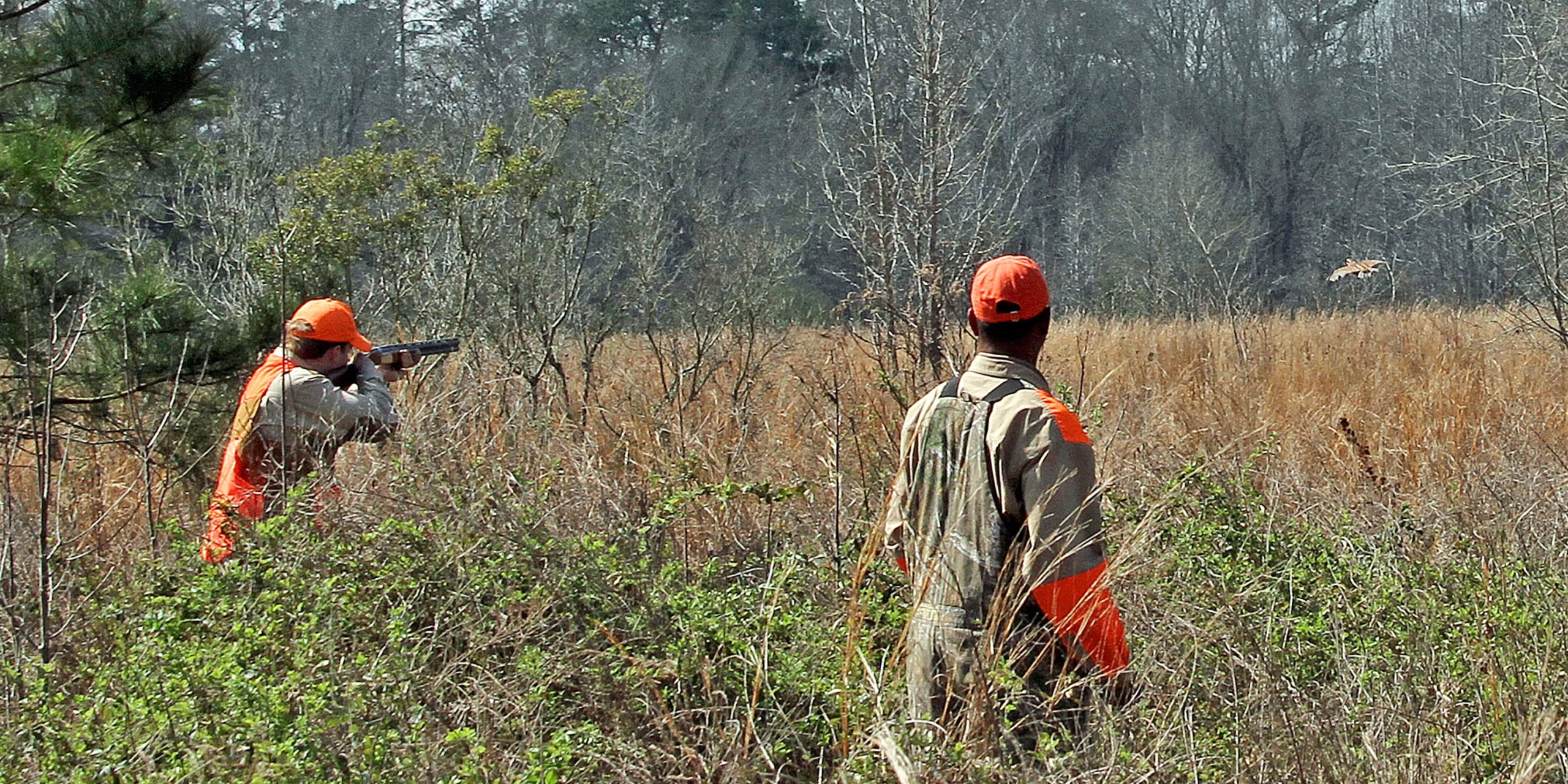
“If you know where to look, you can usually find quail,” he said. “If you find one or two coveys and are able to shoot one or two birds, that’s a successful hunt in my book. It’s still a joy to get to go and do that.”
WFF has two focus areas for quail habitat – Boggy Hollow Wildlife Management Area (WMA) and Choccolocco WMA. The Division maintains farming contracts on other WMAs to provide field edges for quail and other small game species.
At the Boggy Hollow WMA in southeast Alabama, WFF is working with the U.S. Forest Service on best management practices for quality quail habitat on 7,000 acres. The habitat at this WMA, located in Covington County, consists of longleaf pine savannas and rolling hills with several creeks running through the area.
The Choccolocco WMA is located in Cleburne County near Heflin. Its Choccolocco Bobwhite Quail Emphasis Area is about 680 acres, with 13 burn units on a two-year burn rotation in a checkerboard pattern. About 25 acres of warm season crops of sorghum and corn are planted in different strips and fields throughout the area. When not being planted, fallow fields, roadsides and trails are disked.
On Boggy Hollow, quail hunting is allowed only on Wednesdays and Saturdays through February 28 with a reduced bag limit of four birds. Choccolocco quail hunting is also allowed on Wednesdays and Saturdays, but through February 10 with a bag limit of four birds. Check www.outdooralabama.com/
“The bobwhite is an icon of the South,” Blake said. “It’s a conservation effort most people can get behind.”
David Rainer is an award-winning writer who has covered Alabama’s great outdoors for 25 years. The former outdoors editor at the Mobile Press-Register, he writes for Outdoor Alabama, the website of the Alabama Department of Conservation and Natural Resources.