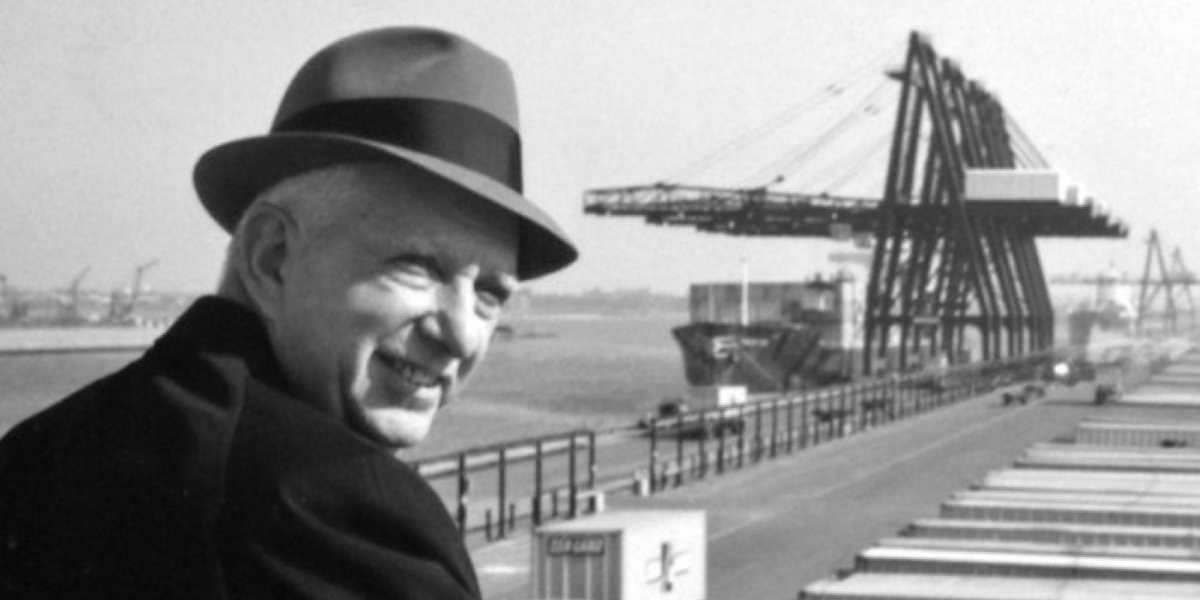
Our global economy is underpinned by the ability to move goods and food relatively efficiently across the world, allowing producers and consumers to connect. From bananas to microchips, luxury goods to automobile components – global trade has created a higher standard of living for billions of people and fostered the creation of trillions of dollars of wealth. The developments that made this possible are numerous and beyond the scope of this paper. But one thing is certain, containerization changed the world and this paper is a tribute to the extraordinary Malcom McLean, the driving force behind it all.
Businessmen and women that are ambitious and achieve success must have some attributes in common. They might be exceptional at operations and developing processes or perhaps they excel at strategy. Maybe they are particularly adept at finance. Some have the ability to identify and develop talent. Malcom McLean excelled at each.
Malcom was born in 1913 near Maxton, NC, the son of a farmer who also had a postal route. He was the second oldest child of six siblings, two of which would later join him in business. Like many smaller towns in rural areas, hard work was a way of life, and some initiative was helpful. Malcom’s first venture was a shoeshine service near Maxton’s town square, where many of the population of about 1,300 people regularly shopped. At the age of fourteen Malcom, when finished with his chores after school, would head to town with his shoeshine kit. His sales pitch was a “shine for a dime.”
After graduating high school in 1931 Malcolm’s first job was stocking shelves at a local grocery and he quickly progressed to the front of the store. He heard of a gas station in nearby Red Springs that needed a manager. He applied for, pursued and won the job. He had enough experience to know that details matter and quickly had the station organized. Malcolm also displayed an early eye for marketing prompting him to take a page from the organ grinders, which were very popular at that time. He bought a monkey to entertain the customers, particularly the ones with children.
Sales soon increased at the gas station convincing the owner he had made the right hire.
The Red Eagle station bought gas from a distributor in Fayetteville, about twenty-eight miles away. Malcom watched every cost detail carefully and noted that the trucker hauling the gas charged a fee of $5.00 for his services. After running some numbers and checking out an old trailer that had been rusting in a nearby yard, he proposed to the gas station owner a cost saving option – let Malcom buy a used truck, fix up the trailer and haul the gas himself. The owner agreed and with one truck McLean Trucking was born in 1934 when Malcom was all of twenty-one years old.
He would continue driving a truck for several years. Throughout his career, Malcom watched costs carefully while looking for innovations that would create a strategic advantage. From the start he looked for people that shared his passion for excellence. Soon his younger brother Jim and his sister Clara joined him at McLean Trucking. Together they pursued business, relying on cost management and customer satisfaction as customers knew they could rely on the McLeans. A nice client list developed, including the R. J. Reynolds Company. By 1940, McLean Trucking had thirty operating trucks and revenues of about $230,000.
And by 1945 the company had 162 trucks and about $2.2 million in annual revenues. While regulated by the Interstate Commerce Commission (ICC), Malcom realized that profitable growth required an ongoing cost advantage. From integrating the sales process into full cost pricing amidst accountability in all departments, McLean Trucking became the employer of choice.
Malcom also knew competitive and capable people wanted to work with a winner. His time behind the wheel gave him a perspective other owners might not have. This provided him with empathy that led to incentive programs that aligned customer experience with employee quality and company profitability. By the end of 1945 McLean Trucking was known for being able to make a route profitable when others could not.
Malcom turned to buying or leasing ICC – approved routes other companies could not make economically viable and added six hundred additional trucks from 1947 to 1949. This scale allowed the company to act strategically. A load of cigarettes heading north to New England could have a truck return a load south of any number of goods in the post-World War II economy. Armed with this efficiency and effectiveness, Malcom proposed cutting freight cost in half for R. J. Reynolds in 1947.
By 1954 McLean Trucking was one of the largest trucking companies in the U.S. with about $11.4 million in revenue. In that same year, Malcom would meet Walter Wriston, a young banker at National City Bank. Wriston and McLean developed a business and personal relationship. Walter would eventually become Chairman and CEO of Citicorp. Meanwhile, McLean Trucking was nicely executing on efficiencies and scale. Malcom’s own experience as a driver, and certainly as an entrepreneur, trained his eye on a situation hardly efficient – shipping ports.
Over the course of several centuries, from sails to steam and other fuels, not much had changed about the way a ship was loaded, unloaded and then reloaded. From all by hand to some evolution in machinery, as of 1954 it was still a highly labor-intensive process that often took weeks and had the additional reality of shrinkage amidst all the hands involved. Malcom first saw it through a windshield of a truck but armed with his ever-present yellow pad, he devised a different process.
What if cargo was loaded into containers that were transported off a truck or by rail, directly on a ship and then unloaded in the same container onto a flatbed truck trailer or railcar? The potential reduction in cost could be very material, and, after all, freight was just a cost that could reduce a good’s price and, as Malcom often noted – “Price sells.” He also knew that cargo shipping by ports was, like trucking, regulated and with applicable statutes, including the Jones Act, which required that movements among U.S. ports be on U.S.-built and owned vessels.
To achieve the vision, Malcom needed ships and established routes. The ships would have to be fitted, unions engaged and port authorities nurtured then converted. In short, a transformation of significant proportions. By now, Malcom was wealthy, a long way from shining shoes. He had a place in New York City and a highly profitable trucking business he enjoyed running with his brother and sister. An April 1953 article in the Winston-Salem Journal Sentinel, “Truck Cab to Swivel Chair: The Story of the McLeans,” underscores the success they had achieved together.
A less ambitious man might have just rode the wave. But Malcom started looking for a shipping company to buy. Pan-Atlantic Steamship had operating rights to sixteen ports and four ships voyaging from Boston to Houston. It was a wholly owned subsidiary of Waterman Steamship Corporation, a publicly traded company headquartered in Mobile, AL. After some inquiries, Malcom discerned that Waterman could be bought for about $42 million. Funding that would require capital and a plan.
In today’s capital markets disaggregation of working capital, disposing of non-core assets and recapping financial capital while refocusing operations are everyday things. They were not in 1954. Malcom McLean and Walter Wristen executed what surely must have been one of the first leveraged buyouts, and with considerable success.
Waterman had about $25 million in cash, an unleveraged balance sheet, thirty-seven ships, a hotel and some other non-core assets. Malcom presented his plan to Wriston – offer shareholders $42 million and acquire the firm, immediately utilize excess cash to retire some of the debt, sell the hotel and other non-core assets and retrofit the ships for containers. Wristen presented the plan to the credit committee at the bank. While initial reviews were positive, the plan encountered some turbulence as the credit committee approached a decision.
Wristen messaged McLean that his direct presentation was needed. Fortunately, Malcom was in NYC then and quickly made his way to the bank and met with Wriston’s superiors. The presentation must have been compelling as the loan was approved. One of the VPs did note to McLean that Wristen was “just a trainee”. Malcom responded, “…he’s going to be the boss of you both pretty soon.”
The evolution from sailing ships to moving cargo was on. McLean Trucking, now publicly traded, had provided a source of wealth for Malcom but regulations limiting ownership in shipping and trucking would eventually be a problem and a solution was for Malcom, Jim and Clara to put their shares in trust and eventually sell. By 1956 the first ship, the Ideal X, a T-2 tanker built in 1945, had been retrofitted as a container ship and set sail from Newark to Houston with all 58 slots booked. Before this voyage it was generally understood that freight costs were about $5.58 per ton. After this voyage was complete, Malcom’s team ran the numbers and the per ton cost was about $0.16.
Eventually, this business became known as Sea-Land and, in addition to Jim and Clara, Malcom added capable leaders in Paul Richardson, Ken Younger, Bernie Czachowski, Charles Cushing,
Ron Katims and Ken Johns. Later on in his career, Malcom would add John McCown, a Harvard MBA, to his team. McCown today is one of the most highly regarded experts on global shipping.
By 1969 Sea-Land was thriving and virtually every other maritime shipping company, and every major port, had followed Malcom’s playbook. But capital necessary to compete was such that Malcom was looking for a good strategic fit. The very profitable R.J. Reynolds Company, flush with cash and well capitalized, made sense and that year a deal was done – Malcom would become a material shareholder in RJR and, for a while, a board member.
But Malcom McLean was a builder of companies and people. His value as a board member of RJR wasn’t the best use of his time. Malcom would also later invest in some significant real estate ventures – Diamondhead, in south Mississippi and Pinehurst, the venerable North Carolina golf resort. His curiosity and genuine desire to develop people played on in his life after the RJR transaction.
By 1972 he had developed a friendship with Fred Smith, an ambitious businessman from Memphis, who had a vision of transporting goods by air/ground promising overnight delivery. Smith’s early calculations of cost and margin benefited from McLean’s input and soon Fed Ex began. It’s just one of many impacts Malcom had on people. Here is another.
In 1987, the same year RJR would be acquired in a $24 billion leverage buy out via an irony only an investment banker could love, Malcom met Thomas Harris, who had founded Merchant Capital in Montgomery that same year. Thomas had heard of Malcom’s plantation, named Sehoy, in Bullock County, Alabama and had reached out to Malcom. Active in politics at that time, Harris was looking for a venue to have a major political event at. It was a longshot, but he overnighted a letter to Malcom at his residence in the Pierre Hotel in NYC.
Not without charm himself, Harris convinced Malcom to make Sehoy available, which McLean had bought from some duPont family members. What a place to have an event – 28,000 acres (with 7,000 additional acres leased), a golf course, exquisite house, superlative quail courses, a 500-acre lake and a runway you could land any jet on! Sehoy was in another league, and every guest went away impressed. Numerous guests of note during Malcom’s years there included – Bing Crosby, Sam Walton, Griffin Bell, Lewis Grizzard and others. From 1987 to his death in 2001, Malcom and Thomas enjoyed a special friendship, and we’d see Malcom from time to time visiting in our Merchant Capital offices, where I then worked.
On one occasion, I’d guess about late 1997 or early 1998, Malcom was in Montgomery and Thomas asked me to meet with him and discuss our budding, but certainly small, investments we hoped to scale. We went over each one and Malcom listened carefully, asking perceptive questions and relaying shrewd observations but with gentle encouragement. I already had received a MBA by then but that afternoon I got a second one.
Malcom McLean passed away on May 27, 2001. His funeral was held at the 5th Avenue Presbyterian Church in NYC. A number of former colleagues, employees and, of course, extended family all arrived to bid farewell. Thomas Harris was seated between Fred Smith and Walter Wriston.
John McCown writes that he and some others made calls to contacts in the shipping industry with an idea – how about a moment of silence during the service while ships in NY’s port blew their horns? The idea spread across the globe.
At 11:20 edt that day the officiant noted the moment of silence during the service. At virtually every port across the world ships blew their horns in tribute to the extraordinary Malcom McLean.