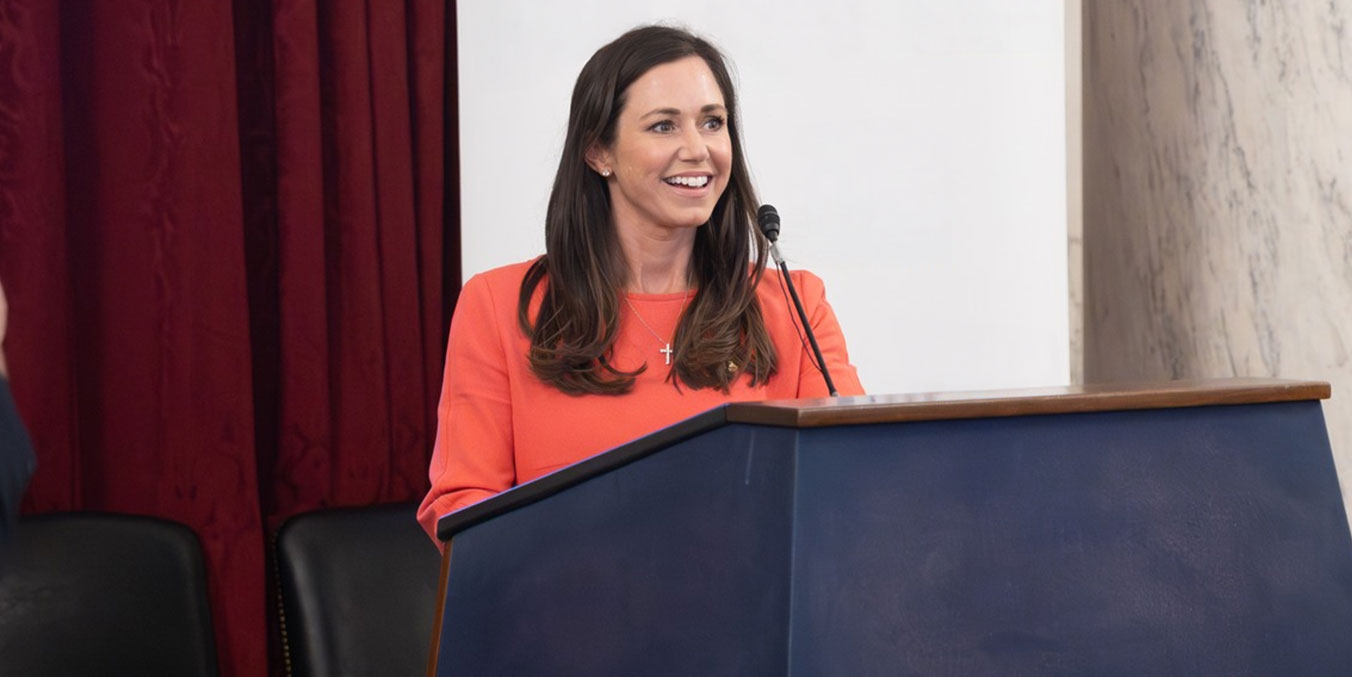
Federal legislation led by U.S. Sen. Katie Britt (R-Montgomery) to strengthen law enforcement tools to combat financial fraud targeting seniors is moving forward in the U.S. Senate, a step Alabama Securities Commission Director Amanda Senn says could significantly benefit fraud prevention efforts across Alabama.
The bipartisan Guarding Unprotected Aging Retirees from Deception (GUARD) Act, led by Britt and Sen. Kirsten Gillibrand, (D-N.Y.), was originally introduced in July 2025 and advanced out of the Senate Judiciary Committee in February 2026. The bill now awaits consideration by the full Senate.
According to Britt’s office, the GUARD Act would expand how state and local law enforcement agencies can use existing federal grant funds to investigate financial fraud, particularly scams involving digital assets and blockchain transactions. The measure also authorizes greater federal assistance to state and local investigators using blockchain tracing tools.
“Last year, Senator Britt co-sponsored with Senator Gillibrand a bill that’s called the Guard Act … and it would provide resources to the states, of course, including Alabama, to help fight these financial frauds and scams and cybercrimes and technology fraud that you and I have been talking about for the past several months,” Alabama Securities Commission Director Amanda Senn told Troy University Public Radio.
“This will help provide law enforcement the tools that they need to better help prevent the millions of dollars that we’re seeing lost from fraud and cyber crimes in Alabama,” she said.
She noted that modern fraud investigations frequently involve online transactions and blockchain movement that require specialized software and licenses to trace.
According to committee materials, the GUARD Act focuses on fraud schemes that disproportionately target older Americans, including technology-enabled scams and so-called “pig butchering” operations, where criminals build trust with victims before stealing funds. The bill is designed to close enforcement gaps by allowing more grant funding to be directed toward blockchain-based investigative work and cross-agency cooperation.
Senn said national movement on the bill signals growing recognition of the scope of the problem facing states like Alabama.
“We’re thrilled about the national recognition of these crimes and the resources that may be available to help combat these ever evolving and more sophisticated crimes,” she said.
The bill now heads to the full Senate for consideration.
Sherri Blevins is a staff writer for Yellowhammer News. You may contact her at [email protected].