A bill targeting surprise billing for ground ambulance services has cleared the Alabama Senate and is now working through the House, where it faces opposition from the state’s largest farm organization over concerns about higher insurance premiums for rural Alabamians.
SB269, sponsored by State Sen. Bobby Singleton (D-Greensboro), passed the Senate and was referred to the House Insurance Committee. Its companion, HB400, sponsored by State Rep. Ed Oliver (R-Dadeville), has cleared the House Ways and Means General Fund Committee but has not received a full House vote.
The bills would require health insurers to reimburse ground ambulance providers at 200% of the Medicare Ambulance Fee Schedule rate for in-network providers and 180% for out-of-network providers, beginning October 1, 2026.
Providers would be prohibited from billing patients beyond their in-network cost-sharing amount, effectively banning surprise billing for ambulance services. Both bills would sunset on June 1, 2029.
In a recent op-ed, Oliver framed the legislation around what he described as a systemic failure leaving rural communities without reliable ambulance coverage.
Oliver argued the current reimbursement structure creates an incentive for unnecessary hospital transports because ambulance services receive little or no payment when they treat patients on scene without transport.
The bills’ “treat in place” provision would reimburse EMS providers for evaluating and treating patients at the scene, keeping ambulances available for true emergencies.
“This isn’t just about saving money,” Oliver wrote. “It’s about saving time. And in emergency medicine, time is often the difference between life and death.”
The Alabama Farmers Federation, which operates Alfa Insurance, argues the bills would raise premiums for the Alabamians least able to absorb the cost.
The federation notes that Medicaid and Medicare patients are exempt from the bills’ provisions, and that federal ERISA law prevents Alabama from mandating rates for self-funded employer plans.
That leaves self-employed individuals, farmers, small business owners with commercial plans, and teachers and state employees to bear the increased costs.
Alfa also argues the financial benefits would flow disproportionately to large companies in metro areas rather than the rural providers the bills’ supporters say they are trying to help.
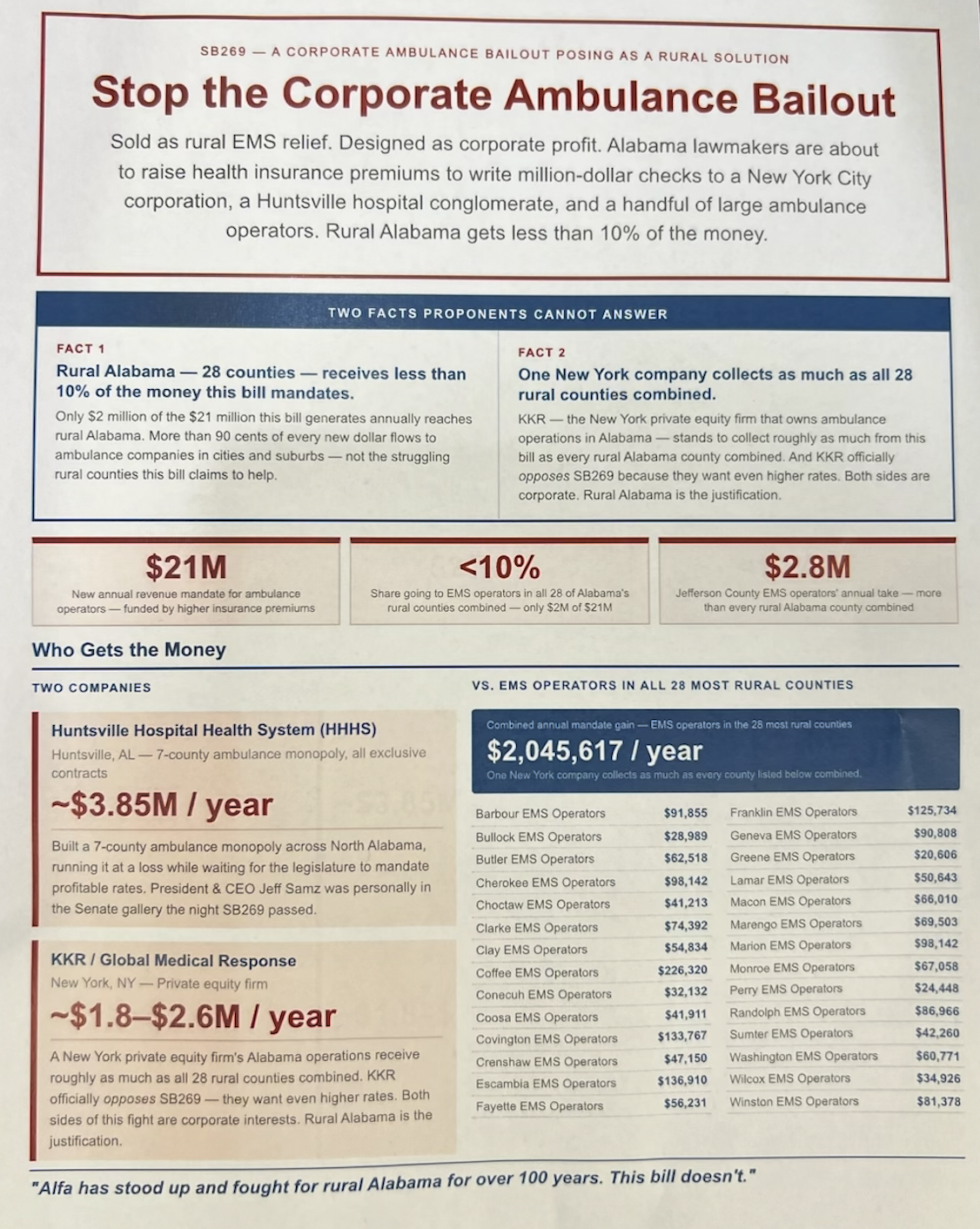
The federation contends that 90% of additional reimbursement money would go to a handful of large metro-area companies, with only 10% reaching the 28 most rural Alabama county EMS providers — and that a single New York private equity firm, KKR, behind Global Medical Response, whose AMR/Lifeguard operations have a footprint in Alabama — stands to collect roughly as much from the bill as all 28 rural counties combined.
According to Alfa’s analysis, that amounts to only about $2 million of the estimated $21 million the bill would generate annually reaching rural Alabama — meaning less than 10 percent of the new money would go to the struggling counties this bill is supposed to help, while more than 90 cents of every new dollar would flow to ambulance companies in cities and suburbs.
“SB 269 will raise insurance premiums for the 10 percent of Alabamians already struggling most to afford health coverage,” the federation said.
Alfa said it remains open to alternative solutions to Alabama’s rural EMS access problems but opposes the bills in their current form.
If enacted, the Alabama Department of Public Health would be required to hire an outside consultant to study the legislation’s impact on EMS access and report findings to legislative leadership by December 1, 2028.
Sawyer Knowles is a capitol reporter for Yellowhammer News. You may contact him at [email protected].