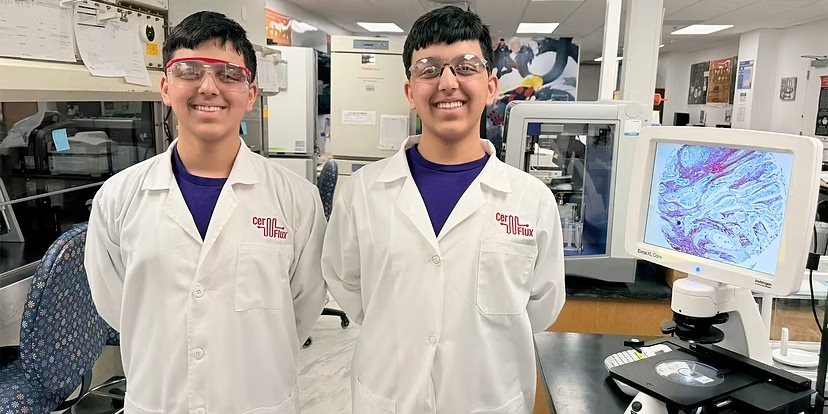
A group of middle school students from the Alabama School of Fine Arts (ASFA) is receiving national recognition for work rarely associated with students their age: using artificial intelligence to study the effectiveness of cancer treatments.
The ASFA students have been awarded a $1,000 Promising STEM Innovation Award in the 2025–2026 Samsung Solve for Tomorrow national competition for a cancer research project developed in collaboration with Birmingham-based biotech company CerFlux.
Selected from thousands of student submissions nationwide, the ASFA middle school team was recognized for a project that applies AI and advanced imaging tools to better understand how tumor structure influences whether cancer treatments succeed or fail.
While cancer research is typically the domain of universities and professional laboratories, these students are working with real-world scientific methods—analyzing data, interpreting digital pathology images and using artificial intelligence to examine the tumor microenvironment.
Their project, titled “Human-Relevant Method to Match Cancer Treatments to Tumors,” blends biochemistry, computational analysis and AI to explore how treatments could be better matched to individual patients.
Rather than focusing on abstract concepts, the students are tackling a concrete medical problem: why certain cancer therapies work for some patients but not for others.
By studying tumor structure and treatment response through AI-supported analysis, the students’ work mirrors techniques increasingly used in modern biomedical research.
ASFA Math Science Instructor Dr. Walter Uhoya, who mentors the team, said the recognition highlights what young students can accomplish when exposed early to complex scientific challenges.
“This recognition shows what’s possible when students are introduced to complex scientific problems early and are trusted to solve them with their natural curiosity and out-of-the-box thinking,” Uhoya said.
Beyond the classroom, the project connects STEM education to broader real-world impacts. Cancer treatment failure contributes significantly to global healthcare costs and lost productivity, and research aimed at improving treatment matching could help reduce those burdens.
While the students’ work is exploratory, it introduces them to how AI and data-driven tools are reshaping medicine.
CerFlux CEO and research advisor Dr. Karim I. Budhwani emphasized the importance of engaging students in meaningful scientific work at an early age.
“This project demonstrates the power of early exposure to meaningful, real-world STEM experiences,” Budhwani said. “That science and new knowledge is about making a difference in the lives of real people.”
ASFA, a state-funded public school serving grades 7–12, is known for blending rigorous academics with creative disciplines. Its math and science program places students in advanced, research-oriented environments that encourage hands-on problem-solving — an approach exemplified by this project.
For the middle school students involved, the award represents more than prize money. It marks an early step into fields where artificial intelligence, medicine and innovation increasingly intersect — and shows that impactful research can begin well before college.
Sherri Blevins is a staff writer for Yellowhammer News. You may contact her at [email protected].