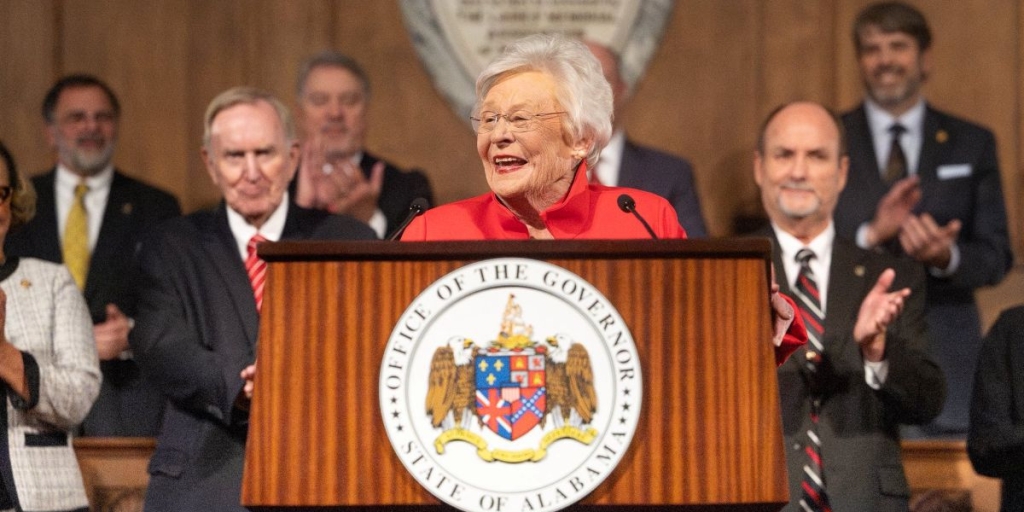
Governor Kay Ivey and the Alabama Republican Party have announced their support for the reform package making its way through the Alabama Legislature this session — and praised lawmakers for “making sure families come first, and that the system is transparent, responsible, and focused on the public interest.”
HB403, HB399, and HB392 will receive their first committee treatment today at 11 a.m. in the House Committee on Transportation, Utilities and Infrastructure .
On Tuesday, Ivey said the legislation is part of an ongoing effort to keep Alabama’s cost-of-living advantage intact while the state continues to recruit major industry and job-creating projects that depend on reliable, affordable power.
“For Alabama to remain the best state to live, work and raise a family, we have to grow the state, while keeping our cost of living low. That certainly includes our utilities, and we are seeing discussions in states around the country about best ways to lower those bills for families. Through a package of bills, we are taking steps to protect energy costs for Alabamians, while keeping our state competitive for further economic development,” Governor Ivey said.
“In addition to maintaining Alabama’s low cost-of-living and growing business and industry, I have also been proud to make strong appointments to the Public Service Commission specifically. My appointments of PSC President Cynthia Almond and PSC Commissioner Chris Beeker show what a future Administration could do to serve the people of Alabama well through this regulatory commission. I thank the Legislature for working on this very relevant issue.”
Alabama Republican Party Chair Joan Reynolds also praised GOP lawmakers for leading bipartisan work to protect Alabama families from rising utility costs while strengthening transparency and accountability in utility oversight.
“This is what leadership looks like,” Reynolds said. “Republican lawmakers didn’t just show up with talking points, they brought Democrats to the table and put forward real solutions that protect families, safeguard ratepayers, and keep Alabama moving forward.”
Reynolds recognized State Sen. Lance Bell (R-Pell City) State Sen. Andrew Jones (R-Centre), State Rep. Leigh Hulsey (R-Helena) and State Rep. Chip Brown (R-Hollinger’s Island) for their leadership in advancing the package.
The plan includes protections ensuring large-load data centers are responsible for the full cost of the infrastructure and grid upgrades they require, rather than shifting those costs onto existing utility customers. Reynolds said the proposal also reinforces the Public Service Commission’s role in reviewing large-load contracts in the public interest and ensuring system stability as demand grows.
Reynolds also highlighted provisions requiring annual public meetings on rates and costs, along with reforms preventing the use of ratepayer funds for lobbying or political activity.
“Ratepayer dollars should be used to provide reliable service, not bankroll political agendas,” Reynolds said. “These reforms bring sunlight, accountability, and trust back into the system.”
Reynolds noted Alabama is one of only a handful of states that still elects its Public Service Commission, making oversight reforms especially important as the state faces new energy challenges.
“As energy becomes more complex and more central to Alabama’s growth, our oversight must keep pace,” Reynolds said. “Republicans are making sure families come first, and that the system is transparent, responsible, and focused on the public interest.”
HB403 targets the state’s biggest new power users by tightening how the PSC reviews contracts between utilities and large-load data centers.
The bill directs regulators to ensure contracts provide for recovery of the data center’s incremental costs and deliverbenefits” for other customers — a direct attempt to stop infrastructure costs from being shifted onto existing residential and small-business ratepayers.
HB399 focuses on tax policy, rewriting Alabama’s incentives for data processing centers. Among other changes, the measure would cap abatements at 20 years beginning Jan. 1, 2027, and require state sales and use tax collection on purchases made by certain large data processing centers starting that same date.
HB392 is the governance centerpiece. It would phase out statewide PSC elections after the 2026 cycle and move the commission to an appointed model — with the governor appointing the PSC president, and the Speaker of the House and Senate President Pro Tem each appointing an associate commissioner — all requiring Senate confirmation.
Alabama is an outlier in electing regulators for a highly technical body as 40 states appoint, rather than elect, their version of a public service commission.
Grayson Everett is the editor in chief of Yellowhammer News. You can follow him on X @Grayson270.