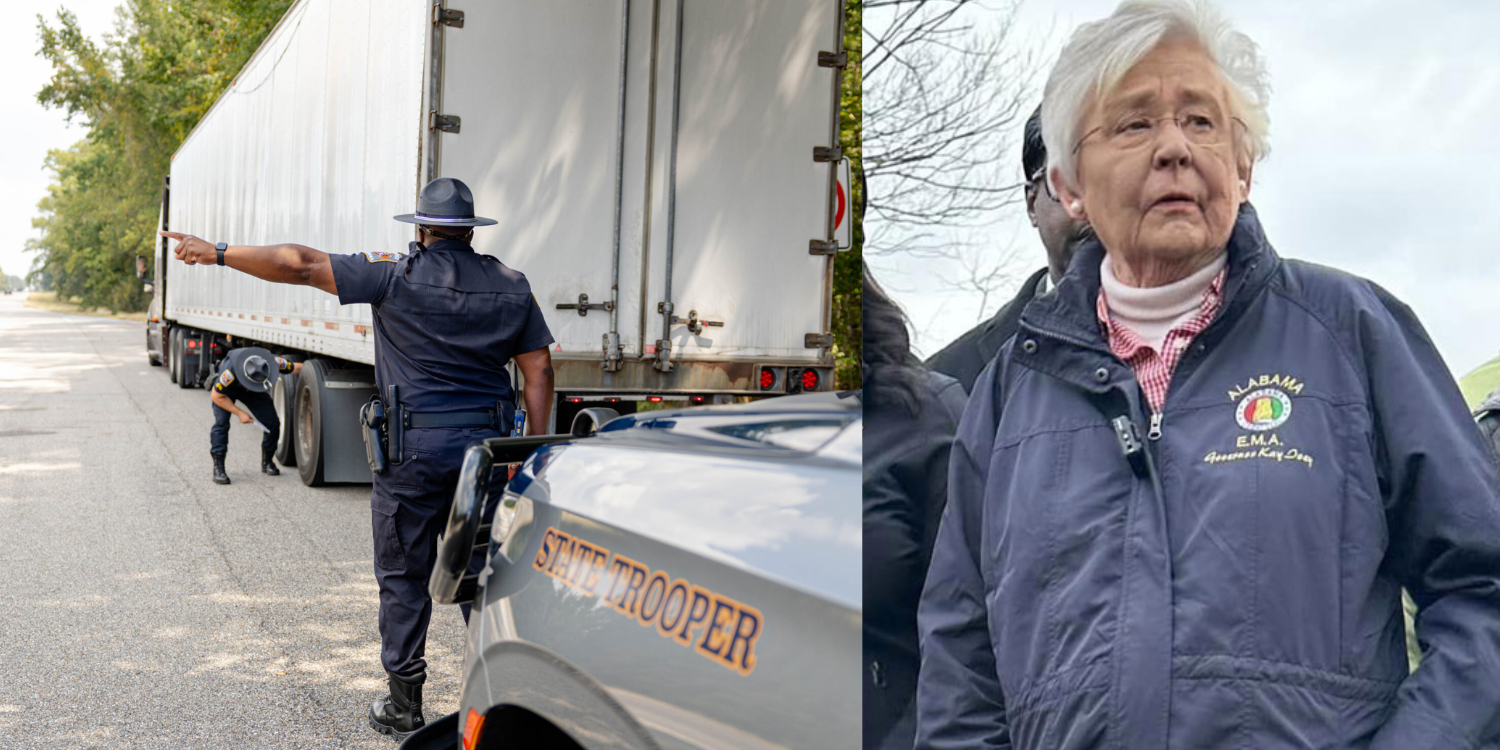
Governor Kay Ivey on Wednesday applauded the Trump administration for launching a sweeping federal initiative to combat fraud and illegal activity in the commercial trucking industry, using the announcement to point back at Alabama’s own record on the issue.
Cracking down on bad actors in trucking has been a priority for Ivey.
Through state enforcement, licensing standards and a working partnership with federal immigration authorities, the governor’s office says Alabama is already delivering results and helping set the national standard for keeping illegal and unqualified commercial drivers off the road.
The U.S. Department of Transportation, Department of Homeland Security and Department of Justice announced Monday what federal officials called their most aggressive interagency trucking enforcement effort to date, a coordinated national approach targeting fraudulent commercial driver training and testing practices, illegal commercial operators and criminal activity inside the industry.
The administration also established the Joint Task Force Crossroads of America, a multistate partnership focused on fraudulent commercial-driver licensing, illegal trucking operations and related criminal activity.
Alabama has been working the same ground through the Alabama Law Enforcement Agency’s (ALEA) Motor Carrier Safety Unit (MCSU), its partnership with U.S. Immigration and Customs Enforcement (ICE) and strict standards governing the issuance of commercial driver licenses, according to the governor’s office.
“President Trump and Secretary Duffy are taking decisive action to restore law, order and accountability to America’s trucking industry, and we are proud to help lead that effort,” Ivey said.
“Here in Alabama, we have already made it clear that those who are in our country illegally, cannot speak English or are otherwise unqualified have no business operating an 80,000-pound commercial vehicle. Through ALEA’s partnership with ICE and the dedicated work of our state troopers, Alabama is helping keep dangerous drivers off our roads and protect law-abiding citizens.”
The governor’s office framed Alabama’s work as the type of state and federal cooperation the new federal initiative aims to strengthen nationwide.
ICE personnel have joined ALEA’s routine commercial-vehicle enforcement assignments when available since the partnership began on October 27, 2025. Two months in, Ivey announced significant results along Alabama’s major interstate corridors — numbers that drew praise from the Trump White House.
ALEA reports that since October 27, 2025, its MCSU has assisted ICE with the detention of 561 individuals for immigration violations encountered during commercial motor vehicle enforcement activities.
Under Ivey’s direction, the agency has also maintained a heavy focus on English Language Proficiency (ELP) requirements for commercial drivers. ALEA reports that MCSU troopers have issued 1,022 ELP violations since January 1, 2025.
Building on those efforts, Ivey in March signed the Highway Safety and Fairness Act. The law requires foreign CDL holders operating in Alabama to possess valid United States work authorization, requires all CDL holders to demonstrate English-language proficiency and makes presenting a fraudulent foreign CDL during an enforcement encounter a criminal offense. It takes effect October 1, 2026.
Alabama Trucking Association President and CEO Mark Colson credited Ivey and ALEA Secretary Hal Taylor with establishing Alabama as a national model for protecting responsible trucking businesses and professional drivers while holding illegal operators accountable.
“Alabama’s trucking industry is built on the hard work of family-owned businesses, independent owner-operators and professional drivers who play by the rules. Bad actors who exploit loopholes in our regulatory systems are putting everyone at risk, and this is unacceptable,” said Colson.
“We are encouraged by the progress being made at the federal level by Secretary Sean Duffy and Administrator Derek Barrs, and proud of Alabama’s strong and timely response to these issues. Governor Kay Ivey and ALEA Secretary Hal Taylor have positioned Alabama as a national leader in combating rogue operations and bad actors, creating safer highways for our citizens and a fairer and more equitable trucking industry in Alabama.”
ALEA says it deploys enforcement resources to high-crash corridors across the state, including areas where ELP and other commercial vehicle violations are prevalent, and that it has observed reductions in CMV-related crashes where that enforcement has been concentrated. The agency recorded 106 fatalities involving commercial motor vehicles in 2025, the lowest annual total since 2021, and reports a 24 percent reduction in CMV-involved fatalities so far in 2026 compared to the same period last year.
“Commercial motor vehicle safety is about much more than conducting an inspection or issuing a citation. It is about making certain the individuals operating these large vehicles are qualified, properly licensed and capable of doing so safely,” said Taylor.
“Under Governor Ivey’s leadership, ALEA has remained proactive in addressing these issues through targeted enforcement, federal partnerships and the work of our Motor Carrier Safety Unit. The progress we are seeing in CMV-related fatalities demonstrates why these efforts remain so important.”
The state also maintains stringent standards for issuing commercial driver licenses. Alabama does not issue non-domiciled CDLs and issues CDLs only to lawful permanent residents — a distinction that put the state ahead of the federal curve when Washington began tightening the rules.
“Alabama did not wait for this issue to resolve itself,” Ivey added. “We took action, we strengthened the law and took illegal operators off our highways. My message is clear: If you are here illegally, operating unlawfully or putting American lives at risk, you will be held accountable.”
Grayson Everett is the editor in chief of Yellowhammer News. You can follow him on X @Grayson270.