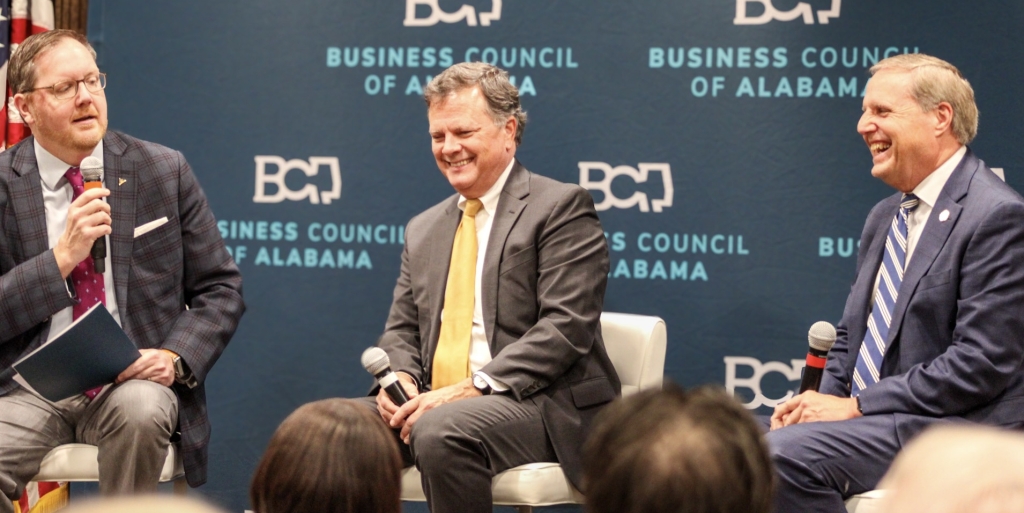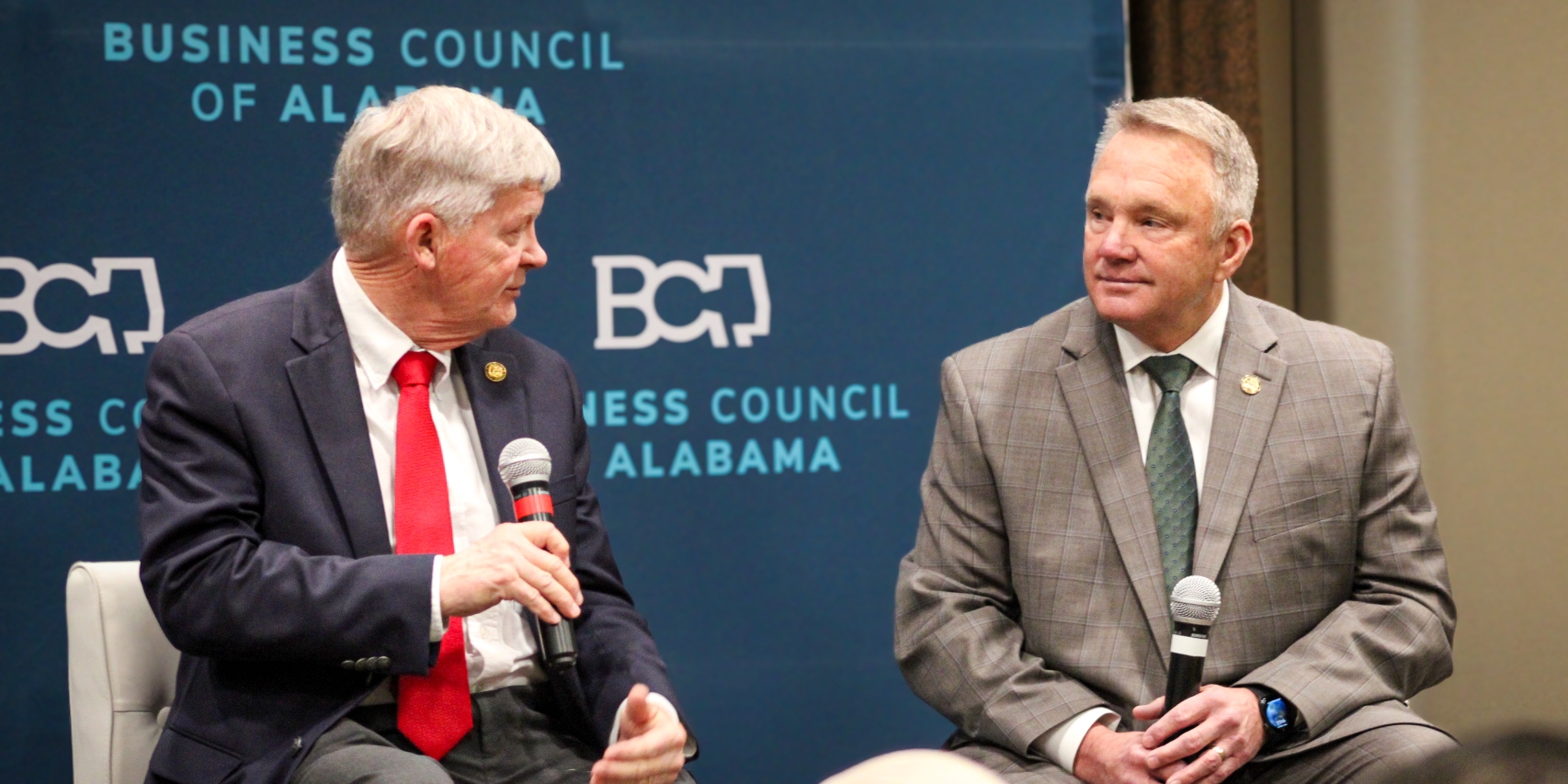
Alabama’s two general fund budget chairmen told a Business Council of Alabama audience Tuesday that the state is better positioned than ever to weather fiscal headwinds, but warned that federal policy decisions, declining interest revenues, and rising healthcare mandate costs could make the next several budget cycles increasingly difficult.
State Rep. Rex Reynolds (R-Huntsville) and State Sen. Greg Albritton (R-Atmore), who chair their respective chambers’ general fund budget committees, spoke at the BCA’s Tuesday morning issues briefing in Montgomery.
Reynolds conveyed a cautiously optimistic note on the state’s near-term finances, pointing to stronger-than-expected January receipts as a sign that Alabama’s economy remains on solid footing.
“January receipts were backed up over 4%,” Reynolds said. “That was $53 million in January. We would not have expected that.”
Reynolds said the state needs to plan its current cash reserves through 2028 and 2029, flagging declining interest income on state accounts as a pressure point to watch. He noted that other revenue sources, including the Simplified Sellers Use Tax and insurance premium taxes, have remained strong enough to partially offset that decline.
Albritton said his biggest concern looking forward is the federal government.
“That’s easy — Feds,” Albritton said. “Not knowing what they’re gonna do, or when they’re gonna do it.”
He pointed specifically to uncertainty around Medicaid funding and the implementation details of the federal Rural Health Transformation Program, a five-year initiative that awarded Alabama $203 million in its first year. While the state knows the funding amount, Albritton said the rules governing how it can be spent remain unclear.
Both chairmen said the state has built stronger fiscal guardrails in recent years to guard against over-reliance on one-time funding, a recurring challenge when large pots of money like federal pandemic relief funds flow into state coffers.
“Everybody in government understands the pitfalls that come about when you get one-time money,” Albritton said. “And yet we all fall into the trap of relying on it in a fashion that turns out to be detrimental in the long run.”
Reynolds pointed to the 2023 budget cycle as an early test of that discipline, when the state used a special session to separately handle roughly $1 billion in American Rescue Plan Act funds rather than folding them into the regular budget process. The state used a portion of that money to pay off $60 million in debt and build up reserves.
Beyond federal uncertainty, both chairmen flagged the steady accumulation of healthcare mandate legislation as a growing budget pressure from within the statehouse itself. Each session brings a wave of bills requiring insurers to cover specific treatments or services, and while individual bills often carry modest price tags, the cumulative cost adds up quickly.
“That’s a death by a thousand cuts,” Albritton said. “The things that come in are usually smaller, they’re usually emotionally driven, and they usually have great examples to cause one to want to support them. But the policy of who’s paying for it — we’re dealing with public money, someone else’s money.”
Albritton pointed to a past tax exemption the legislature believed would cost $35 million that ultimately ran more than $400 million as an example of how cost estimates can go wrong.
Reynolds added that members will often approach him about a bill costing $600,000, without accounting for the dozens of similar bills moving simultaneously.
“We’ve got 30 of them at a million dollars apiece,” Reynolds said. “And that’s what we try to look at.”
Sawyer Knowles is a capitol reporter for Yellowhammer News. You may contact him at [email protected].