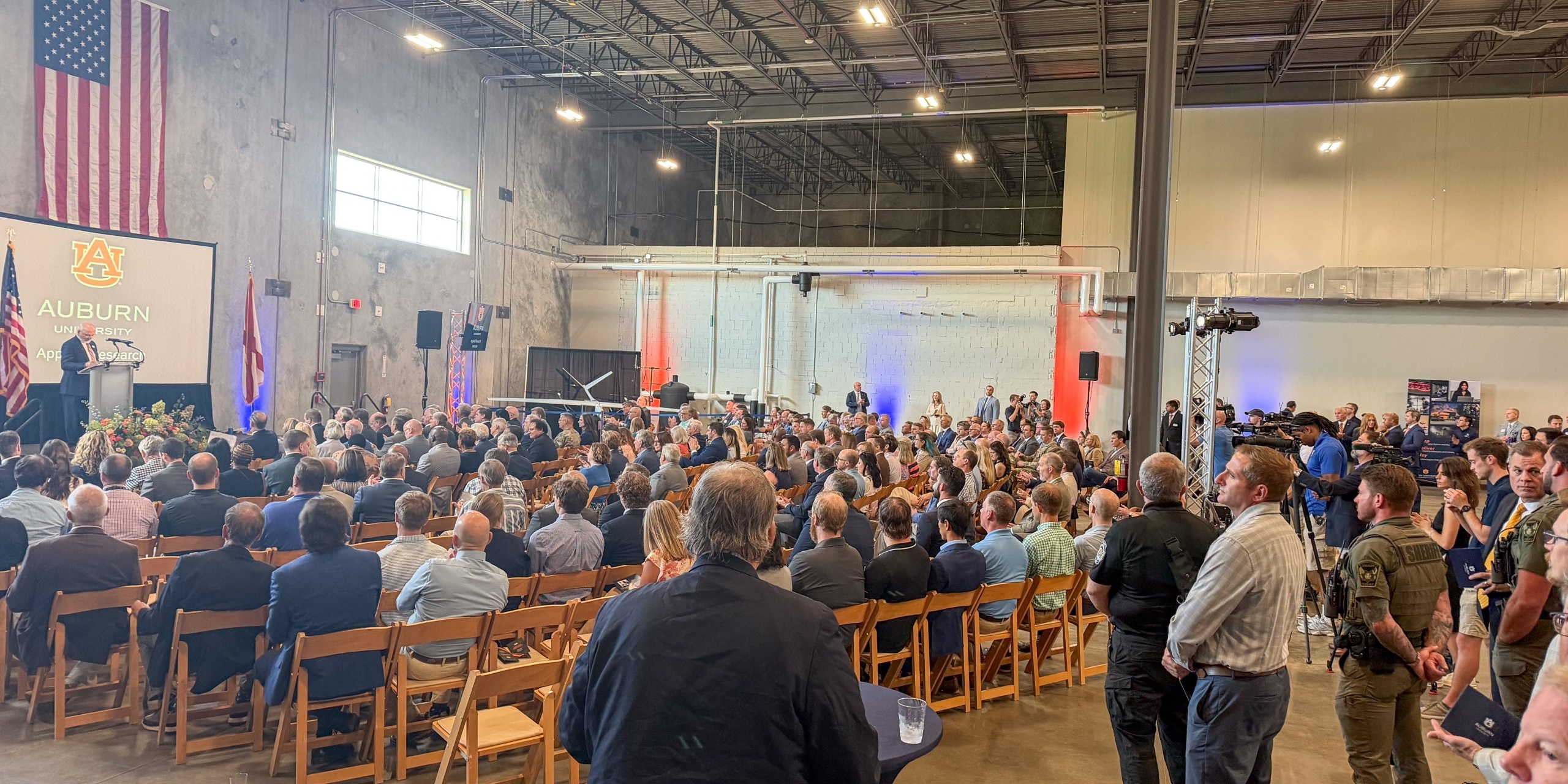
Auburn University opened a new 50,000-square-foot research laboratory Tuesday in Cummings Research Park, putting more than $30 million behind an effort to move critical defense and space technologies from concept to capability faster.
The new Auburn University Applied Research Institute laboratory combines advanced manufacturing, rapid prototyping, space development and operations, and a nationally unique radiation-effects testing capability just minutes from Redstone Arsenal.
The facility was completed in 11 months and is designed to bring Auburn researchers and students together with government and industry partners working on some of the nation’s most pressing national security challenges.
For AUARI Executive Director Jonathan Pettus, the emphasis is on speed.
“We’re building the Applied Research Institute to focus on acceleration, to be an accelerator,” Pettus said.
That includes accelerating technology from the laboratory to operational capability, rebuilding the nation’s ability to manufacture and scale production, and developing the technical workforce needed for the future.
“Our greatest contribution is talent,” Pettus said. “At Auburn University, developing people is our most important product.”
The importance of that workforce was echoed by Assistant Secretary of War for Science and Technology Joseph S. Jewell, Ph.D., who said the new laboratory brings together academia, industry and government at a time when U.S. technological superiority is increasingly tied to national security.
“Innovation is a national security imperative,” Jewell said.
“This laboratory will accelerate technology readiness levels for many critical systems,” he said. “This new facility will ensure that brilliant ideas become programs of record and get into the hands of our warfighters.”
‘They have to work every time’
One of the laboratory’s centerpiece capabilities is high-energy proton radiation-effects testing for space electronics, an area where the Missile Defense Agency has already invested heavily.
Auburn received an $11.4 million MDA contract in November 2024 and another $7.5 million in July to support the capability. Testing is expected to begin in early 2027.
At the center of the facility is a superconducting cyclotron capable of accelerating protons to 200 MeV, allowing researchers to recreate radiation conditions electronics may encounter in space.
Maj. Gen. Jason Cothern, deputy director of the Missile Defense Agency, said access to that testing is critical for systems that cannot afford to fail.
“Our weapon systems have to work every time, all the time,” Cothern said. “Whether it’s one of our interceptors flying through space to take out an incoming missile or a space sensor that’s telling us that that missile is inbound, they both have to work through that radiation environment.”
Cothern said existing radiation testing capacity is limited and spread across the country, often forcing programs to compete for testing time.
“Now this beautiful, amazing facility gives us a dedicated one-stop shop to do all the testing we need to get done in order to ensure that our systems that we deliver work every time, all the time,” he said.
‘Tip of the spear’
U.S. Rep. Dale Strong said Auburn’s location places researchers within minutes of many of the agencies and companies that could ultimately use the technology developed there.
“They’re truly the center of gravity for research and development,” Strong said. “And now we have Auburn bringing more of its research capabilities directly into the Huntsville community.”
Strong (R-Huntsville) said the proximity creates opportunities for collaboration while giving students the chance to work on real national security problems.
“We’re not just teaching our students and younger generations about the problems of tomorrow,” he said. “We’re also giving them the opportunity to solve them right here, right now in North Alabama.”
U.S. Rep. Robert Aderholt focused on another challenge: how long it can take promising technology to reach the people who need it.
“Technology often takes years to reach the battlefield, and by the time it does arrive on the battlefield, it’s already outdated,” Aderholt (R-Haleyville) said.
He pointed to Auburn’s Pathfinder program as an example of connecting university researchers and students directly with immediate military needs.
“It’s about a groundbreaking program that our university’s sharpest minds are helping solve immediately in real time by bypassing the traditional acquisitions process,” Aderholt said.
House Armed Services Committee Chairman U.S. Rep. Mike Rogers said growing national security demands will require both more advanced technology and the engineers to develop it, making Auburn’s investment in Huntsville particularly important.
“Huntsville is going to be the tip of the spear in whatever we do when it comes to national security space, the space economy and also defense technology,” Rogers (R-Saks) said.
‘We live in a dangerous world’
U.S. Sen. Tommy Tuberville said the urgency behind the facility reflects an increasingly difficult global security environment.
“We live in a dangerous world,” Tuberville (R-Auburn) said. “Our warfighters rely on cutting-edge technology to maintain their competitive edge. That starts right here.”
Tuberville said traditional development timelines are no longer sufficient.
“We have to work faster,” he said. “We need research that works at mission speed.”
He said the combination of advanced manufacturing, rapid prototyping and testing can shorten the path from an idea to something service members can actually use.
“Facilities like this aren’t just housing fast machines,” Tuberville said. “They’re cultivating America’s most valuable resource: our students and our current and future workforce.”
‘We win’
Huntsville Mayor Tommy Battle placed Auburn’s investment within a research legacy Huntsville has spent more than six decades building.
Battle pointed to Cummings Research Park, now the nation’s second-largest research park, and the concentration of engineers and technical professionals surrounding the new facility.
“We win when we protect the United States and we protect the sanctity of this nation,” Battle said. “We win when we start putting a man on the moon and take them to Mars in the future. We win because of the work done here.”
Auburn students, faculty, engineers and scientists will work from the new laboratory alongside partners including MDA, NASA, the Space Development Agency, U.S. Space Command, U.S. Space Force and multiple Army organizations.
Auburn University President Christopher B. Roberts said the facility represents the university’s growing commitment to work already centered in North Alabama.
“The future is very bright,” Roberts said, “and the future is being built right here in Huntsville.”
Courtesy of 256 Today